
The search box you built your business on is disappearing. For twenty years the game was simple: rank on page one, earn the click, win the customer. That model is breaking in front of us. In early 2026, roughly 68% of Google searches ended without a single click, according to Search Engine Land, up from about 50% in 2019. People get answers directly from AI and never reach your site. This is why the SEO vs AEO conversation matters right now. If you only understand traditional search engine optimization, you are optimizing for a world that is shrinking. If you understand Answer Engine Optimization, you are optimizing for where attention is actually going.
At M16 Marketing, we do not treat this as a fashionable rebrand. It is a genuine shift in how discovery works. The brands that adapt get named inside AI answers. The ones that do not quietly vanish from the conversation, even if their rankings still look fine on paper. This article breaks down the real difference between SEO and AEO and the strategy that wins as search enters its next era.
Key Takeaways
- SEO helps people find your website. AEO helps AI systems understand, trust, and recommend your business.
- Roughly 68% of Google searches ended without a click in early 2026 (Search Engine Land), so ranking alone no longer guarantees traffic.
- AEO is built on top of SEO, not instead of it. The two are complementary, not competing.
- The core shift is from ranking to citation: winning means being the source an AI names, not just a blue link.
- Google AI Overviews now appear on about 48% of queries and reach roughly 2 billion monthly users (theSTACC).
- AI referrals convert far better than organic, at 14.2 to 15.9% versus 1.76% for Google organic (SE Ranking).
What Is the Difference Between SEO and AEO?
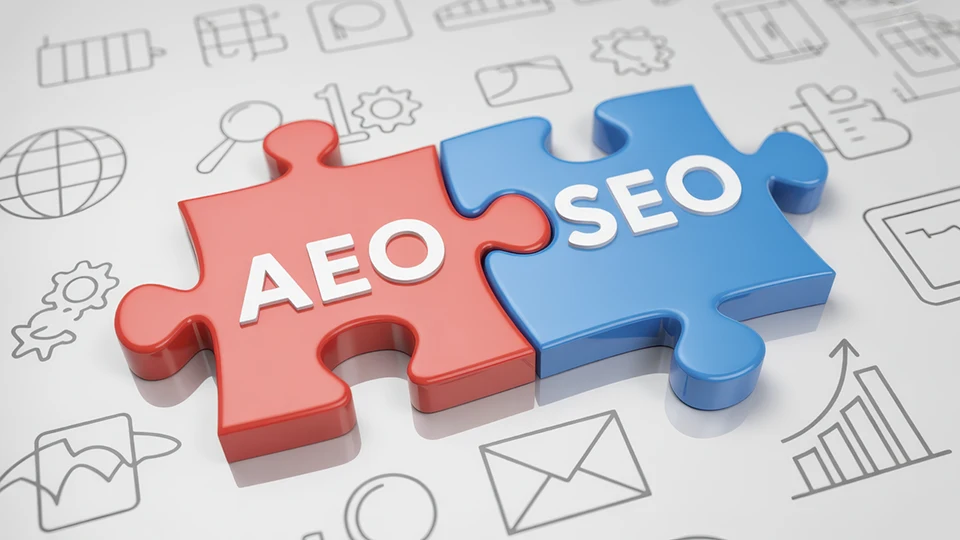
SEO vs AEO comes down to one question: are you optimizing to be found, or optimizing to be cited? Search Engine Optimization (SEO) is the practice of improving a website so it ranks higher in traditional search results and earns clicks. Answer Engine Optimization (AEO) is the practice of structuring your content and brand so AI systems can understand it, trust it, and cite it inside generated answers. SEO targets a ranking position on a results page. AEO targets a mention inside the answer itself. Both rest on the same foundation of quality content and clean technical structure, but they optimize for two different outcomes: a click versus a citation.
Why the Shift From SEO to AEO Matters
The economics of search have flipped. When an AI answers the question directly, the click you used to depend on never happens. SparkToro reports fewer than one in three searches now sends a click to the open web. Google AI Overviews make this concrete: they appear on about 48% of queries, up 58% year over year, and reach roughly 2 billion monthly users, according to theSTACC. When one appears, click-through to traditional results drops about 60% and roughly 83% of those searches end without a click. Google AI Mode ends without a click about 93% of the time after passing 1 billion monthly users in 2026. The message is blunt: ranking is no longer the same as being seen.
Here is the part that gets missed: the traffic that does flow from AI is worth more. SE Ranking found ChatGPT referrals convert at 14.2 to 15.9%, versus 1.76% for Google organic, roughly nine times higher. Fewer clicks, but far more qualified ones. That is the strategic case for AEO: the visibility is scarcer, more valuable, and it goes to the brands AI chooses to cite. Understanding how AI search works is the first step to earning that citation.
Ranking vs. Citation: The Core Difference
The single most important idea in the SEO vs AEO debate is the move from ranking to citation. Under SEO, ten blue links compete for position and the click is the prize. Under AEO, the AI synthesizes one answer and names a handful of sources. You are no longer trying to beat nine other results. You are trying to become part of the answer.
That changes what winning looks like. Traditional SEO success is a rank and a click. AEO success is a citation and a recommendation. This is why we tell clients that in the future of search, the brands that are cited will outperform the brands that are simply ranked. A page can sit at position three, carry real authority, and still be invisible if the AI never pulls it into the answer.
Citation is also harder to fake. AI systems lean on trusted, well structured sources: Wikipedia and Reddit together account for roughly 66% of all AI citations across platforms, which tells you these engines reward established authority and clear consensus. To compete, your content has to be structured, quotable, and verifiable enough that a model is comfortable putting your name behind an answer. That work lives in citation-worthy content and clean structured data for AI.
How Are SEO and AEO Different? A Side-by-Side Comparison
The clearest way to see SEO vs AEO is head to head. They are two layers of one search strategy, and the table below shows where they diverge.
| Dimension | Traditional SEO | Answer Engine Optimization (AEO) |
|---|---|---|
| Primary goal | Rank higher and earn the click | Get cited and recommended inside AI answers |
| Where you win | Search engine results page (SERP) | Inside the generated answer (AI Overviews, ChatGPT, Gemini, Perplexity) |
| Unit of success | Ranking position and click-through | Citation, mention, and share of voice |
| Who consumes it | Human searchers | AI systems, then humans |
| Content style | Keyword-focused pages built for scrolling | Definition-first, quotable, structured answers |
| Key technical assets | Crawlability, page speed, backlinks | Schema markup, entities, verifiable facts |
| Most important structure | Title tags and headings | Organization schema and entity clarity |
| How trust is signaled | Domain authority and links | Consistent entities, citations, and corroboration |
| Success metric | Traffic and rankings | AI share of voice and referral quality |
| Time horizon | Established, maturing | Emerging, compounding fast |
Underneath every row, both disciplines demand the same things: genuinely useful content, a technically sound site, and real authority. Organization schema, the most important schema type for AEO, strengthens your SEO footprint too. You are not choosing a side. You are adding a layer.
Where SEO and AEO Overlap
It is tempting to frame this as a war. It is not. Every AEO gain depends on SEO fundamentals that already worked: a crawlable site, fast pages, credible links, and content that answers a real question. If an AI cannot crawl and parse your page, it cannot cite you. If your content is thin, neither a human nor a model will trust it.
The difference is what you add on top. AEO layers in entity clarity, structured data, quotable definitions, and consistent brand facts so machines can interpret and repeat your content with confidence. One earns the crawl, the other earns the recommendation. That is why we run them as a single program rather than two competing budgets, an integrated approach at the heart of our SEO services.
Real-World Examples
Consider a professional services firm ranking on page one for its core terms yet quietly summarized out of the answer whenever an AI Overview appears. The rankings look healthy. The pipeline does not. The fix is not more keywords. It is restructuring content into clear, quotable answers, adding organization schema, and reinforcing the entity so the model trusts the source.
At M16 Marketing, we have found that the brands earning AI citations are rarely the ones with the biggest keyword footprint. They are the ones with the clearest structure and the most consistent facts about who they are. When a client’s entity data is clean and their content answers questions directly, AI systems start naming them, and the referral traffic that follows converts at a rate ordinary organic traffic cannot touch.
The opportunity is spreading across platforms as ChatGPT’s share of AI referrals fell from about 89% in mid-2025 to roughly 63% in early 2026 (SE Ranking), with Claude, Gemini, and Perplexity all gaining ground. Top brands already capture 15% or more share of voice on core query sets, and enterprise leaders reach 25 to 30% in their verticals, according to DigitalApplied. That is the new scoreboard, and measuring AI visibility is how you keep score.
Best Practices
- Build AEO on a healthy SEO foundation. Fix crawlability, speed, and content quality first, then layer AEO on top.
- Lead with definitions. Open key sections with a clean, standalone answer a model can lift and cite.
- Deploy organization schema and entity markup so AI systems can identify and trust your business.
- Structure content for extraction: descriptive headings, short direct answers, tables, and verifiable facts that align with the broader consensus.
- Track share of voice across ChatGPT, Gemini, Perplexity, and AI Overviews, not just rankings.
Common Mistakes
The biggest mistake is treating SEO vs AEO as an either/or decision. Teams either cling to old-school ranking tactics and ignore AI, or chase AEO while their technical SEO crumbles underneath. Both fail, because AEO without SEO has no foundation to stand on.
The second mistake is scaling low-value content to game the machines. Google’s February 2026 core update cut traffic 40 to 60% for scaled low-value AI content, according to Rankability. Volume is not a strategy. Citability is.
The third mistake is optimizing for one AI platform when ChatGPT’s referral share is dropping toward 63% as Claude, Gemini, and Perplexity grow. The fourth is measuring only rankings, which hides the moment AI summarizes you out of the answer. Getting this balance right is a strategy problem before it is a tactics problem, which is where a clear digital marketing strategy earns its keep.
Frequently Asked Questions
Is AEO replacing SEO?
No. AEO is built on top of SEO, not instead of it, and depends on the same fundamentals: crawlability, quality content, and authority. The smart approach runs both together, using SEO to be found by engines and AEO to be cited by AI systems.
What is the main difference between SEO and AEO?
SEO optimizes to rank a page and earn a click. AEO optimizes to be cited inside the AI-generated answer itself. SEO targets a ranking position; AEO targets a mention and a recommendation. The core shift is from ranking to citation as AI answers questions directly.
Does SEO still matter in 2026?
Yes. Crawlability, structure, and authority are exactly what AI systems use to decide which sources to trust and cite. Ranking alone no longer guarantees traffic, since roughly 68% of Google searches ended without a click in early 2026 (Search Engine Land), but SEO remains the foundation AEO is built on.
Why does citation matter more than ranking now?
Because AI answers directly and names only a few sources. When AI Overviews appear, click-through to traditional results drops about 60% and roughly 83% of searches end without a click (theSTACC). If you are not cited in the answer, your ranking may never be seen.
Is AI traffic actually valuable?
It is more valuable per visit. SE Ranking found ChatGPT referrals convert at 14.2 to 15.9%, versus 1.76% for Google organic, roughly nine times higher. AI referral traffic is still small at around 1.08% of all web traffic (Similarweb), but it converts at a premium.
What is the most important technical step for AEO?
Organization schema is the most important schema type for AEO. It helps AI systems identify your business as a clear, trusted entity. Combine it with entity markup and structured, quotable content so models can confidently cite your brand.
Conclusion
SEO vs AEO is not a battle you have to pick a winner in. It is a progression. Traditional SEO helps people find your website. Answer Engine Optimization helps AI systems understand, trust, and recommend your business. In the search era we are entering, the brands that are cited will outperform the brands that are simply ranked, and AEO is built on top of SEO, not instead of it.
The takeaway is simple. Keep your SEO foundation strong, because it is what makes AEO possible, then layer citability on top: clean entities, structured data, and quotable answers across every AI platform that matters. At M16 Marketing, we run these as one integrated program because that is how discovery works now. The companies that treat this as a strategy problem, not a tactics problem, will own the answer, and the future of search becomes an advantage instead of a threat.
Continue Learning
- What Is Answer Engine Optimization (AEO)?
- What Is AI Marketing?
- What Is Agentic AI?
- How to Build an AI Marketing Strategy
- Human-Led AI Marketing: Why Strategy Still Wins
- What Is a Marketing Operating System?
Sources: – Search Engine Land: Google zero-click searches 2026 study – SparkToro: Less than one-third of Google searches send a click – theSTACC: Google AI Overview statistics – SE Ranking: ChatGPT referral traffic – Similarweb: Generative AI stats – DigitalApplied: AI share of voice tracking framework – Rankability: Does Google penalize AI content?


